
AI Marketing Operations Platform – Strategy to execution in one operating system
Marketing teams and founders feel constant pressure to deliver growth with less headcount and smaller budgets. Many respond by working longer hours or buying more tools but results rarely change in a meaningful way. The real issue usually sits deeper than effort or talent. It sits in the way strategy, planning, workflow and reporting exist as separate islands. When that happens, even skilled teams struggle to move from intention to consistent impact.
The phrase “strategy to execution” sounds simple yet most organizations experience a wide gap between the two. Strategy lives in a slide deck that few people read after launch. Plans exist in scattered spreadsheets and email threads. Campaigns run through disconnected systems that share little context. Reporting arrives weeks late and rarely shapes what happens next. This pattern leads to busy calendars, confused priorities and limited visibility into true performance.
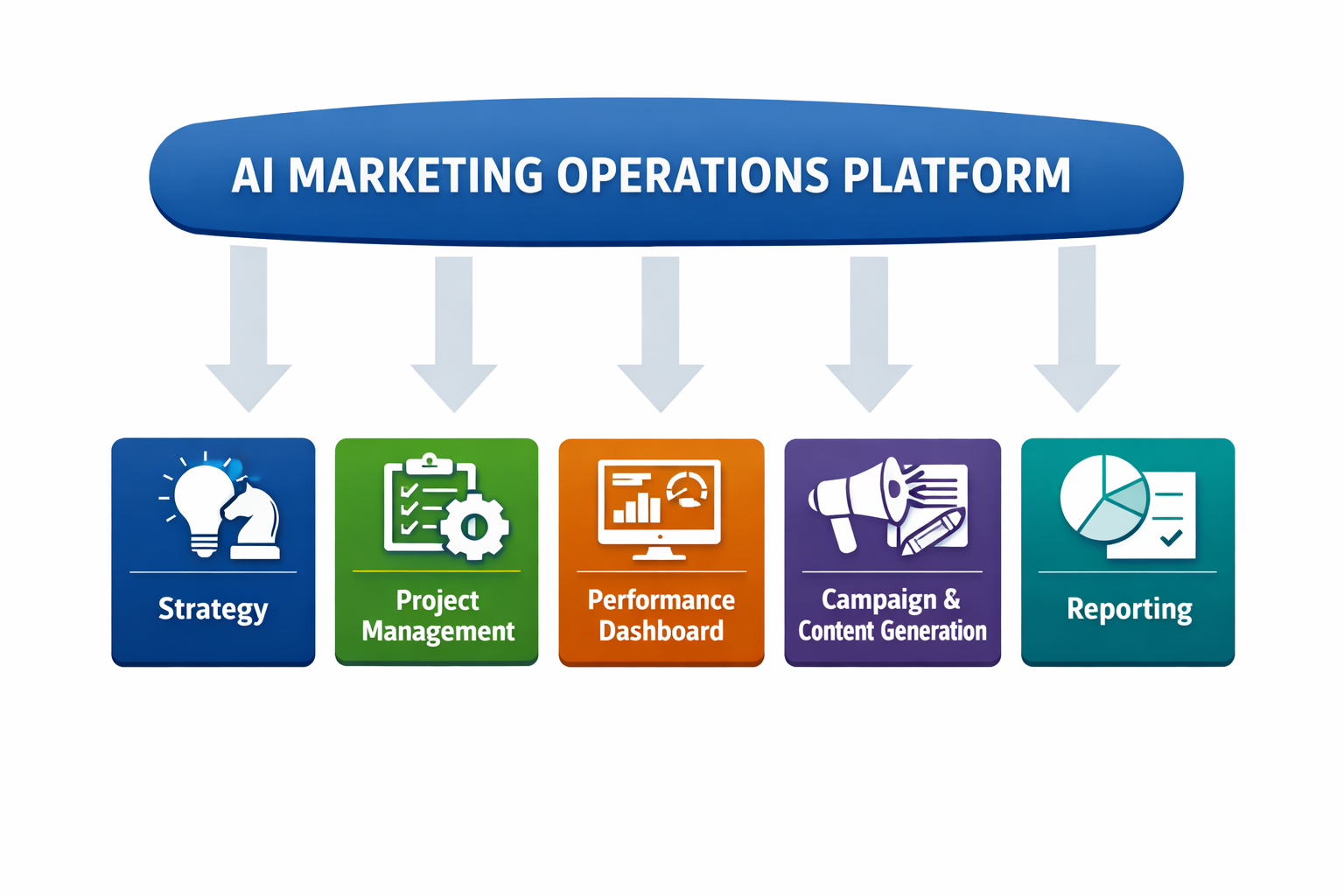
An AI marketing operations platform aims to close that gap by connecting the full cycle in one operating system. It combines AI marketing strategy, structured workflows and a unified digital dashboard for performance. Instead of treating strategy as a static artifact, it treats it as a living system that drives day to day work. This shift changes not only what marketing teams deliver but how they think, decide and improve. It turns marketing into an operating discipline rather than a sequence of isolated activities.
As AI capabilities mature, many leaders ask a difficult question. Do they add yet another tool focused on content production, or rethink the operating model itself. The second path requires more thought but offers far more leverage. When AI connects strategy, workflow and learning, it reduces friction across the entire marketing lifecycle. That is the real promise of an AI marketing operations platform that runs strategy to execution in one operating system.
What an AI marketing operations platform really is
An AI marketing operations platform is not just another task system with a few smart features. It is marketing operations software that sits at the intersection of strategy, workflow, execution and measurement. Think of it as a marketing operating system that holds the logic behind what the team does and why. Instead of living in documents scattered across folders, this logic lives in one connected hub. Every campaign, task and report traces back to that shared core.
At its heart, such a platform aligns four disciplines that often drift apart. Strategy and planning define goals, audiences, budgets and priorities. Operations and workflow convert those choices into programs, projects and tasks. Execution support provides repeatable processes and governance for campaigns. Performance reporting turns data into feedback that refines the next cycle. When these components connect, marketing stops relying on memory and becomes a repeatable system.
AI changes the equation because it accelerates the steps that once required long workshops and manual synthesis. An AI marketing strategy engine can process inputs and produce structured outputs far faster than traditional methods. A marketing strategy generator can translate business goals into segment definitions, channel priorities and budget guidance. Instead of waiting weeks for a deck, teams can move from concept to operational plan in days. That speed matters when markets and competitors do not wait.
Yet AI alone does not solve fragmentation. The real value appears when AI sits inside an end-to-end marketing platform that connects strategy to execution. This kind of marketing ops platform allows strategy updates to ripple into calendars, workflows and dashboards. It reduces the lag between decision and implementation. It also reduces the risk that strategy becomes a one-time event that never guides real work. The platform effectively becomes the shared brain of marketing operations.
Why strategy must be a living system
Most teams treat strategy as a finished artifact. It receives attention during planning season then slowly fades into the background. An AI marketing operations platform treats strategy as a living system rather than a static file. When goals shift, the AI marketing strategy can adjust priority segments, channel mixes and message themes in near real time. This adaptation keeps execution aligned with current objectives, not last quarter’s assumptions.
Because strategy and workflow live in one operating system, changes do not stay theoretical. A shift in focus can propagate into campaign calendars, task lists and the marketing workflow platform itself. Teams see which initiatives move up or down the list, what must pause and what accelerates. This tight coupling supports true marketing operations management where tradeoffs stay explicit. Leaders can check the digital dashboard and see the impact of strategic choices on actual work.
Making strategy a living system also reshapes decision culture. Instead of debating personal opinions in long meetings, teams refer to shared data and defined priorities. The AI components surface benchmarks, patterns and performance signals. Human leaders decide, but they decide with clearer context and fewer blind spots. That mix of human judgment and AI insight gives marketing planning software a different role. It becomes a constant partner rather than a yearly exercise.
When strategy stays live, it also supports learning across cycles. Insights from the marketing performance dashboard can feed back into the marketing plan generator. The platform can recommend changes to budget allocations or audience focus based on what actually converts. Over time campaigns stop being one-off experiments. They become chapters in a longer narrative shaped by continuous evidence. Strategy, planning and reporting start to function as one integrated loop.
Who benefits from a strategy to execution platform
The idea of a strategy to execution platform appeals to many, but different groups value different aspects. Marketing leaders and in-house teams want clarity across channels and accountability across stakeholders. Entrepreneurs need structure without building large internal departments. Agencies seek repeatability across clients with consistent planning outputs. A unified marketing workflow software platform speaks to each group in specific ways. It creates a common operating language that crosses roles and company sizes.
In-house marketing teams often run lean while attempting to manage broad responsibilities. They juggle product launches, events, content programs and partner campaigns. Without a strong marketing project management software backbone, work tends to rely on individual memory. A centralized marketing workflow platform helps these teams standardize how they translate AI marketing strategy into concrete tasks. It also provides leadership with a marketing reporting dashboard that explains progress and tradeoffs.
Entrepreneurs and founders face a different challenge. They need marketing to perform but cannot justify full teams for every function. Many start with fragmented tools and ad-hoc campaigns, which leads to inconsistent results. An all-in-one marketing platform for teams offers a different path. It gives them marketing planning software, marketing strategy software and marketing campaign workflow software in one place. That structure makes it easier to build a repeatable engine rather than a series of experiments.
Agencies and consultants must scale thinking across many clients and industries. A shared marketing ops platform helps them standardize strategy creation and implementation roadmaps. They can use a marketing plan generator to move faster while still tailoring output to each client. The marketing execution platform then supports handoffs between strategy teams and delivery teams. A robust digital dashboard lets them present outcomes in a structured way, which strengthens client trust.
Reducing tool sprawl and cognitive load
Most marketing organizations accumulate tools over time for each new need. One system for email campaigns, another for social scheduling, another for reporting. Each solves a problem but adds cognitive load and integration overhead. A true marketing operations platform aims to reduce this sprawl at the operational layer. It does not necessarily replace channel tools but it consolidates planning, workflow and performance management in one hub. This consolidation helps teams think clearly and act coherently.
When strategy, plans and workflows live in the same AI marketing operations platform, context follows the work. A marketer can open a campaign and see the linked strategic goals and KPIs. They no longer need to search through documents to remember the rationale behind each initiative. The marketing operations software holds that memory. This reduces confusion when team members change or when agencies step in. Work feels more like a system and less like a patchwork of individual habits.
Tool consolidation also impacts reporting. Instead of building reports manually from several systems, teams can use a central marketing performance dashboard. This digital dashboard can connect channel metrics to strategic objectives defined in the platform. Leaders can finally see whether campaigns support the right goals and segments. They can also compare initiatives against benchmarks surfaced by the AI components. The result is less time spent assembling data and more time spent asking better questions.
Cognitive load matters because marketing complexity rarely decreases. New channels and formats emerge, budgets shift and customer expectations rise. Without strong infrastructure, each new demand adds stress. With a marketing workflow software backbone, new initiatives plug into existing processes. Templates, approval paths and measurement plans already exist. Instead of reinventing operations for every campaign, teams build on a stable foundation that grows with them.
From AI marketing strategy to 12-month program
Every effective marketing engine starts with a clear sense of direction. AI can help convert raw information into a structured AI marketing strategy that people can act on. An advanced marketing strategy software uses inputs such as business goals, competitive context and audience data. It then produces a strategy that covers growth targets, segmentation, positioning and channel choices. Rather than staring at a blank page, teams receive a starting point that reflects both data and best practices.
This AI marketing strategy output matters only if it flows into execution. That is where a strategy to execution platform changes the game. The same AI marketing operations platform can translate strategy into a 12-month program. It can outline campaign waves, channel cadence and milestones month by month. Teams move from abstract statements like “increase market share” to specific sequences of activity. This programmatic approach builds momentum and rhythm instead of sporadic bursts of activity.
Many teams try to build a year plan using static documents and scattered spreadsheets. That approach often breaks down when priorities change or new opportunities appear. A dedicated 12 month marketing plan software component avoids this problem. It holds the plan inside the marketing operating system itself. Adjustments to goals or constraints can update timelines, budgets and workloads automatically. The marketing planning software becomes a living calendar that keeps strategy real.
A strong 12-month program typically includes several elements. It defines key themes that organize campaigns into coherent stories. It sets channel cadence across email, social, PR, content and paid efforts. It links activities to clear owners and deadlines. It embeds planned measurement points into each phase so learning stays continuous. When these elements live inside marketing project management software, everyone sees the same roadmap. The team can finally move as a coordinated unit.
The role of AI in planning discipline
Planning discipline separates teams that react from teams that steer. AI supports that discipline in several ways within a marketing workflow platform. It can benchmark budget allocations against similar companies to avoid under or overspending. It can suggest channel mixes based on historical patterns and industry norms. It can highlight gaps in audience coverage or overreliance on a single tactic. These suggestions do not replace human judgment but they raise the floor for quality decisions.
An AI driven marketing plan generator can also reduce planning fatigue. Many teams struggle to revisit their plans regularly because the process feels heavy. When the platform can refresh scenarios quickly, reviews become less painful. Leaders can ask “what if we shift 10 percent of spend to this channel” and see modeled impact. The marketing planning software turns revision into an exploratory dialog instead of a manual rebuild. This agility helps teams adapt without losing structure.
AI also supports prioritization, which often creates tension between stakeholders. By connecting initiatives to objectives and constraints, the marketing operating system can score projects. It can consider expected impact, effort and strategic relevance. Decision makers then discuss tradeoffs using shared criteria rather than loudest voice. This approach aligns with modern marketing operations management practices, which emphasize transparency in resource choices. It ensures that the 12-month plan reflects actual strategy rather than only urgent requests.
Planning discipline does not remove uncertainty, but it changes how teams face it. An AI marketing operations platform provides a clear base plan along with a way to adjust systematically. When new data arrives through the marketing performance dashboard, the loop closes. Teams update priorities based on evidence, not only instinct. That pattern builds confidence internally and with executive stakeholders who depend on marketing for growth.
Marketing workflow software as execution backbone
Even the best plan fails without a strong execution backbone. That backbone often takes the form of marketing workflow software embedded within the AI marketing operations platform. It converts the 12-month program into structured campaigns, tasks and approvals. Instead of each team member working from personal lists, everyone works from one shared view. The platform orchestrates who needs to do what, by when and in what sequence.
A robust marketing workflow platform supports structured campaign setups. Each initiative includes objectives, target segments, key messages and required assets. Templates help teams follow consistent patterns for similar campaign types. This consistency reduces ramp up time and avoids reinventing the wheel for repeatable work. It also simplifies handoffs when team members change or agencies support specific parts of execution. The process itself becomes an asset rather than a burden.
Marketing project management software capabilities matter here as well. The platform must manage dependencies, workloads and capacity across individuals. It should flag when timelines collide or when teams carry unrealistic volumes. These features help leaders negotiate scope and sequence before issues explode. Instead of discovering problems near launch dates, they see risk signals early. This visibility supports healthier conversations about tradeoffs between speed, quality and coverage.
Because execution sits inside the same marketing operations platform as strategy and planning, context stays present. A marketer drafting assets can view the AI marketing strategy and campaign brief without leaving the system. The marketing operating system holds customer insights, positioning guidance and message frameworks. This reduces inconsistency in tone and focus across channels. It also supports faster onboarding for new team members, who can learn from embedded guidance.
Governance, approvals and accountability
Execution quality depends not only on creativity but also on governance. A marketing workflow platform allows organizations to define clear approval paths for different types of work. High risk content might require legal review while routine posts need only manager sign off. The system can route tasks accordingly instead of relying on informal habits. This structure avoids last minute surprises and ensures compliance with brand and regulatory standards.
Accountability also grows stronger when work sits inside marketing project management software. Each task has an owner, due date and connection to broader goals. The platform can surface overdue items, blockers and bottlenecks. Leaders gain an honest view of where projects stall and why. That transparency helps them remove barriers or adjust expectations rather than guess. It also supports fair recognition of teams that carry heavy execution loads.
Governance features extend to documentation and knowledge. The marketing workflow software can store briefs, learnings and debrief notes linked to each campaign. Over time this creates an institutional memory that new initiatives can reference. Teams avoid repeating old mistakes because they can access past findings easily. This habit pairs naturally with a marketing reporting dashboard that shows results for each initiative. Conversation about improvement becomes part of routine execution rather than an occasional event.
Accountability does not mean surveillance. When designed well, a marketing ops platform gives individuals more control over their work. Clear expectations, shared context and visible priorities reduce confusion. People know how their tasks connect to AI marketing strategy and company goals. They spend less time hunting for information and more time applying their skills. Execution feels purposeful rather than reactive, which benefits both performance and morale.
The power of a unified digital dashboard
Many organizations talk about being data driven yet pull reports manually from multiple tools. This lag reduces the impact of insights on actual decisions. A unified digital dashboard within an AI marketing operations platform addresses this gap. It aggregates performance data across campaigns and channels into a single view. Because it ties directly to the strategy and plan inside the system, metrics carry clear meaning. Numbers appear in context rather than as isolated figures.
A strong marketing performance dashboard answers several core questions. Which campaigns drive the most meaningful outcomes relative to spend. Which segments respond best to specific messages or channels. How do current results compare to benchmarks or historical patterns. The AI elements inside the marketing operating system can surface patterns that humans might miss. They can suggest where to adjust budget, focus or creative approaches. Leaders then decide how far to follow those suggestions.
The same platform can function as a marketing reporting dashboard for different stakeholders. Executives may want high level views of pipeline contribution, new customers and brand metrics. Marketing leaders may care more about channel performance, cost per lead and conversion quality. Team members may focus on engagement metrics for their specific initiatives. Because the dashboard connects to the same underlying data, each view remains consistent. Arguments about “whose numbers are right” gradually fade.
Real time or near real time visibility also improves course correction. When teams wait for month end reports, they often miss chances to improve live campaigns. A marketing operations platform that streams data regularly allows for mid flight adjustments. If a message underperforms, teams can test alternatives quickly. If a channel outperforms expectations, leaders can reallocate resources with evidence. Data turns from a historical record into a steering tool.
Closing the loop from reporting to strategy
Reporting only matters if it changes action. A strategy to execution platform closes the loop by feeding insights back into planning. Performance data updates the models that support the marketing plan generator. Campaign outcomes refine assumptions about audience behavior and message resonance. The AI marketing strategy layer then incorporates these learnings into future recommendations. Over time the system reflects the specific reality of the business, not only generic benchmarks.
This closed loop embodies the idea of marketing operations management as a continuous cycle. Strategy sets direction, planning shapes programs, execution delivers campaigns and reporting drives adaptation. When all sit inside one marketing operating system, that cycle becomes smoother. Teams do not need to manually translate insights into new documents because the platform handles much of that connective work. Humans still make the key choices but with better scaffolding.
Closing the loop also builds trust between marketing and other functions. When sales or finance ask about impact, marketing can reference the marketing reporting dashboard. They can show not just vanity metrics but clear links between activity and business outcomes. This transparency reduces suspicion that marketing spend lacks accountability. It also invites more constructive collaboration on future initiatives. Other functions can see how their input shapes strategy inside the AI marketing operations platform.
As this loop strengthens, organizations start to view marketing less as a cost center and more as a managed system. Discussions shift from “what campaign should we try next” to “how do we adjust the system for better yield.” The technology becomes part of the organizational memory that outlasts individual employees. That resilience matters when teams change or markets shift abruptly. The operating system keeps running even as the people using it rotate.
Marketing operations management as a discipline
The rise of AI and integrated platforms brings fresh attention to marketing operations management. This discipline focuses on how marketing work gets done, not only what messages say. It covers processes, technology, data and governance. An AI marketing operations platform gives this discipline a concrete home. It turns abstract ideas about efficiency and control into specific workflows, dashboards and guidelines. Organizations that treat operations seriously often outperform those that treat it as an afterthought.
One core principle of marketing operations management is standardization where it helps and flexibility where it matters. A marketing workflow platform can standardize briefs, approval paths and reporting templates. At the same time, it can allow creative teams freedom within defined parameters. This balance reduces chaos without suffocating innovation. AI tools support this by handling repetitive structure while humans focus on nuanced judgment. Together they raise the baseline for quality.
Another principle is transparency. Marketing project management software inside the platform sheds light on workloads, timelines and dependencies. Stakeholders see what the team can realistically deliver and by when. They can also see how new requests affect existing commitments. This transparency encourages more thoughtful prioritization conversations. It also reduces the pressure that comes from hidden bottlenecks. Operations management becomes a shared responsibility rather than a backstage concern.
The third principle centers on measurable learning. With a robust marketing performance dashboard and reporting processes, teams track progress against clear KPIs. They conduct structured reviews that feed back into the marketing plan generator. AI supports pattern recognition across many campaigns and time periods. Leaders can test hypotheses about messages, audiences or channels with more confidence. The discipline emerges not from rigid control but from repeated learning cycles.
Role of marketing planning software and strategy tools
Marketing planning software and marketing strategy software play specific roles within this larger discipline. They provide the frameworks that guide how teams think about goals, segments and initiatives. An AI marketing strategy module can suggest structures that reflect common success patterns. It can help newer teams avoid typical planning mistakes such as chasing too many audiences. These tools give a scaffolding that supports better judgment without dictating every detail.
Because these planning tools sit inside an end-to-end marketing platform, they connect directly to workflow and reporting. Teams do not need to copy information between systems and risk version confusion. The marketing operations platform becomes a single source of truth for strategic intent. Anyone can reference it when questions arise about why a campaign exists or which KPIs matter most. This integration turns planning into something living, not a onetime exercise.
Strategy tools also help align cross-functional stakeholders. Product, sales and finance can engage with shared views of priorities and tradeoffs. They can comment or contribute without needing deep familiarity with marketing workflow software. The platform can present distilled views tailored to each group while drawing from the same data core. This shared alignment makes later execution smoother because disagreements surface earlier. Strategy becomes a shared story rather than a marketing-only document.
In practice, the combination of planning software, AI guidance and integrated execution tools makes marketing feel more intentional. Teams do not simply react to incoming requests or trends. They evaluate each idea through the lens of the agreed AI marketing strategy and 12-month program. The platform supports this evaluation with structure and data. Marketing operations management shifts from tracking activity volume to orchestrating meaningful progress.
From fragmented tools to a true marketing operating system
Many organizations reach a point where adding another tool no longer helps. Calendar reminders, spreadsheets and standalone apps cannot fix structural fragmentation. A marketing operating system offers a different perspective. It treats marketing as a connected set of decisions and actions that must sit in one coherent place. An AI marketing operations platform embodies that system by aligning strategy, planning, workflow and analytics. It transforms marketing from isolated efforts into a sustained operating model.
At the center of this model sits the AI marketing strategy that guides what the organization will and will not do. Surrounding it are planning modules, including 12 month marketing plan software and marketing planning software capabilities. Execution flows through marketing workflow software and marketing project management software modules. Insights surface through a unified digital dashboard, which also serves as a marketing performance dashboard. All connect through shared data and common structures.
This architecture supports a true end-to-end marketing platform that functions as a marketing execution platform. It does not aim to replace every channel specific tool. Instead it coordinates them through shared objectives, workflows and measurements. The marketing operations platform becomes the control room where leaders view progress and make adjustments. It replaces scattered processes with one all-in-one marketing platform for teams who want clarity and accountability.
As organizations adopt such systems, they often see subtle cultural changes. Meetings shift focus from status updates to decision points because the marketing reporting dashboard shows status already. New team members ramp faster because the marketing workflow platform encodes best practices. Leaders spend less time chasing information and more time shaping the next phase of strategy. Work feels less stressful because everyone knows how pieces fit together from strategy to execution.
Why “strategy to execution in one operating system” matters
The phrase “strategy to execution in one operating system” captures a simple but powerful idea. When marketing decisions, plans, tasks and results share one home, momentum builds. An AI marketing operations platform that delivers this integration changes more than workflows. It shifts how teams perceive their work and their role in company growth. Fragmentation gives way to coherent motion. Isolated efforts give way to connected campaigns that build on each other.
This matters especially in 2026, when pressure for measurable outcomes keeps rising. Boards and founders want proof that marketing investments drive growth, not only noise. A marketing operations software stack anchored by a unified operating system gives that proof. It links every initiative to objectives, tracks execution week by week and shows impact visually. It also allows faster adjustments when assumptions fail, which protects both budgets and brand momentum.
The future likely belongs to teams that combine human creativity with structured AI support across the full lifecycle. A marketing ops platform that integrates AI marketing strategy, planning, workflow and analytics provides that foundation. It reduces busywork while raising the quality of decisions. It lets marketers spend more energy on understanding customers and crafting messages that resonate. Technology handles more of the connective tissue that used to drain time.
For organizations tired of juggling disconnected tools and struggling to see what works, this shift offers a path forward. A coherent marketing operating system built as an AI marketing operations platform does more than organize tasks. It reshapes how marketing thinks, acts and learns across the entire journey from idea to impact.