
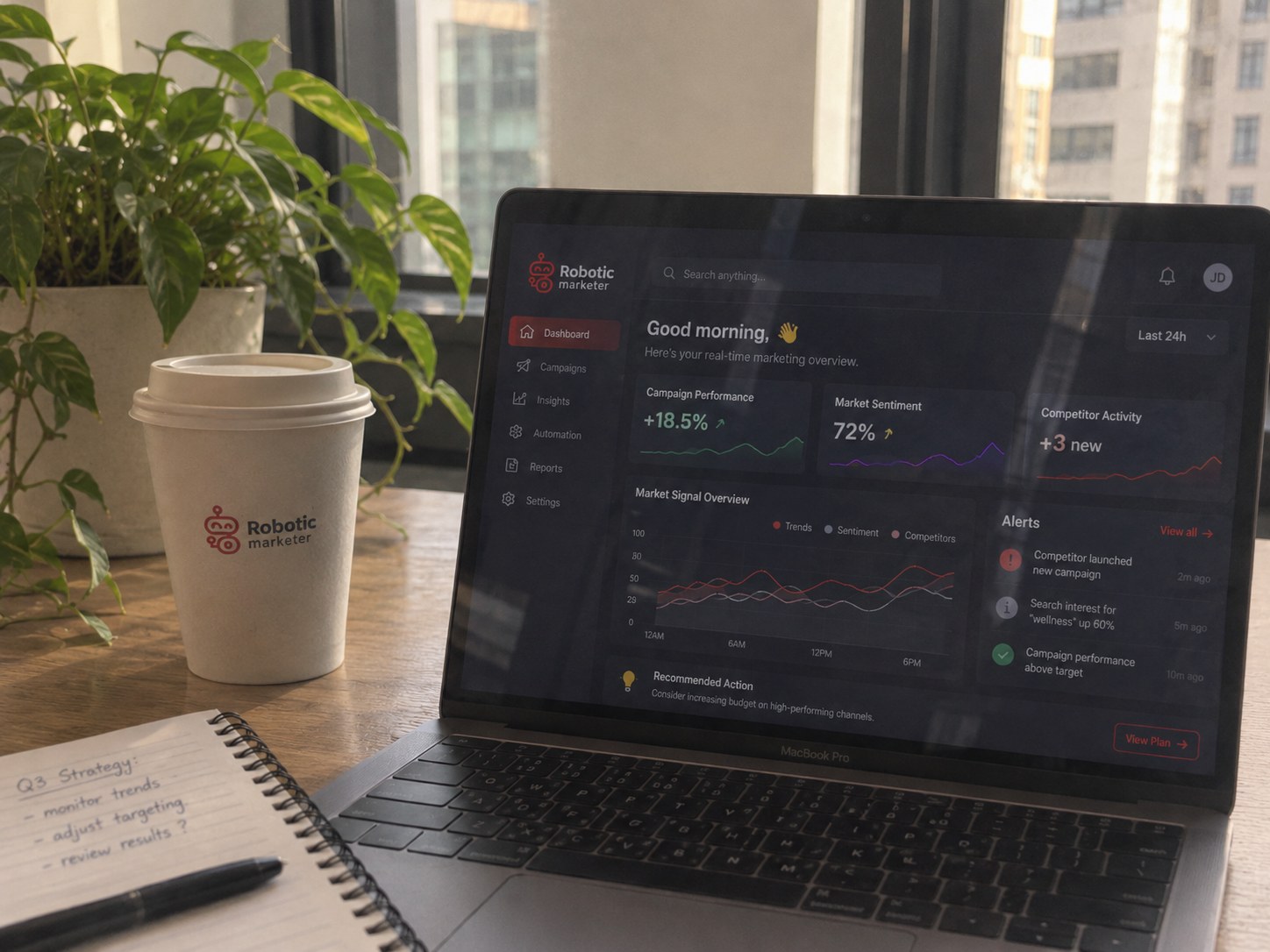
Integrating Real-time Market Signals into Dashboards to Improve Strategic Agility
The ability to interpret and act on real-time market signals now defines the effectiveness of a data-driven go-to-market strategy. Companies integrating these signals within advanced strategic agility dashboards are not simply viewing static reports, they are adapting marketing strategies mid-campaign. The competitive advantage lies in turning raw data into decision-ready insights and prompt execution, using platforms such as an AI marketing operations platform and an AI marketing strategy. Businesses equipped for this pace do more than keep up; they guide their own outcomes.
Understanding real-time market signals
Real-time market signals are immediate data points, trends, and sentiment shifts that appear across the marketplace. These might include direct customer feedback, competitor activity, pricing changes, trending topics, or rapid changes in consumer sentiment. By actively responding to real-time marketing ai input rather than relying on post-campaign analysis, organizations can better align products and marketing strategies with changing customer needs.
Key types of data to monitor
For market signals to add value, businesses must focus on the streams most relevant to their goals. Five categories consistently offer high impact:
- Competitor moves: Immediate updates on new advertising campaigns, messaging shifts, product launches, and promotions help diagnose threats and reveal new opportunities early.
- Market trends: Spikes in keywords, hashtags, and core topics across digital and social channels signal changing interests or unmet needs among buyers.
- Customer feedback: Live reviews, social conversation, support tickets, and direct comments allow companies to identify issues and expectations as soon as they surface.
- Pricing and promotions: Monitoring real-time price updates within the industry helps businesses stay competitive and minimize surprises in fast-moving sectors.
- Influencer and media sentiment: Public reactions from journalists, analysts, and thought leaders can shift market perception quickly. Monitoring this feedback lets companies influence their own brand narrative while issues are still controllable.
Designing strategic agility dashboards
The mere collection of data does little without clear translation to action. Strategic agility dashboards must convert live signals into targeted recommendations, enabling teams to act quickly and effectively. A strong dashboard framework goes beyond visualizing KPIs, making links between signals and their strategic implications unmistakable.
Key features of strategic agility dashboards
- Signal prioritization: Dashboards should highlight significant outliers and trends, guiding attention to data that may require immediate strategic re-evaluation.
- Contextual overlays: Data gains value in context, such as comparing competitor spending directly with internal budgets or evaluating customer sentiment alongside campaign phases.
- Customizable views: Each business function should be able to filter and interpret data according to its unique priorities, marketing, sales, and senior leadership may require different perspectives.
- Alerting and automation: Built-in alerts notify stakeholders when key metrics breach thresholds. These can trigger automated workflows, assign team tasks, or call for immediate management review.
- Integrated project management: The dashboard should link insight to direct action, allowing teams to translate findings into project tasks and timelines without manual re-entry or loss of context.
AI marketing operations platforms: Centralizing signals for smarter marketing
Managing multipoint, real-time signals is beyond the scope of traditional manual processes. An AI marketing operations platform brings scale and structure, automating the flow from signal ingestion to execution. Strategic decisions and actions are orchestrated within one coordinated environment.
Core capabilities
- Aggregates real-time data from digital and offline sources, including social listening, competitor tracking, customer support, and web analytics.
- Benchmarks performance against both internal targets and historic patterns to distinguish urgent issues from normal fluctuations.
- Connects live insights directly to adaptive workflows, automatically reallocating AD spend, refreshing creative, or escalating alerts to leadership based on pre-set criteria.
- Maintains a documented record of every adjustment, making the evolution of strategy traceable for performance review and learning.
- Keeps a strategy-first orientation, ensuring that every action and automation maintains alignment with overall business objectives.
The role of AI marketing strategy in improving agility
An AI marketing strategy acts as a bridge between endless flows of raw data and the execution of precise, high-impact tactics. Rather than relying on gut instinct, organizations gain consultant-grade recommendations built from the current marketplace and past campaign insights. This creates a measurable link between signal, strategy, and outcome.
Direct benefits to marketing performance
- Proactively directs teams to rebalance channels and adjust messaging as external conditions shift.
- Enables predictive analysis, guiding smarter budget allocation toward campaign elements most likely to generate returns.
- Reduces waste by activating resources only where emerging opportunities or customer needs are most apparent.
- Establishes a transparent chain from signal to board-ready reporting, helping marketing teams demonstrate clear return on investment.
- Lowers dependence on larger teams by automating the review and refresh of strategy in response to new live data.
Designing dashboards that drive action
Responding in real time requires dashboards that cut to the core of what influences rapid marketing execution. Irrelevant data can distract from key priorities, so clarity and actionability take precedence over density or cosmetic reporting. Every visual or narrative element must point decisively toward what requires attention now.
Guiding principles for strategic dashboard design
- Clarity: All metrics, visuals, and summaries must relate directly to clear business objectives.
- Timeliness: Real-time or near-real-time updates are essential for metrics that drive major decisions.
- Interactivity: Users must be able to explore underlying data to understand the cause of sudden spikes, dips, or outliers.
- Accessible reporting: Automated insights should convert complex analytics into executive-ready narratives, helping all users, from experts to generalists, to interpret results.
- Continuity: Connect each insight to a broader campaign or event, avoiding standalone data points that lack relevance to strategy.
Continuous strategy reviews using live data
Agile marketing no longer waits for quarterly or even monthly performance reviews. Instead, teams leverage continuous monitoring combined with immediate strategy sessions when key market signals trigger potential action. This results in rapid, evidence-based pivots that keep companies aligned with their goals.
Process best practices
- Use automated alerts to surface critical changes, ensuring that teams respond quickly rather than on a predetermined schedule.
- Hold short, focused review meetings when new data points indicate a significant market development or competitive activity.
- Adopt an always-updating roadmap, refreshing priorities and tactics as new signals arise, rather than committing to inflexible plans.
- Track and attribute each strategic shift to its originating market signal, creating better visibility and accountability for decision quality over time.
Key tools enabling real-time signal integration
Modern marketing automation removes fragmentation from the process of collecting, interpreting, and responding to signals. The most effective systems combine key tools:
- API connectors linking social, search, competitor intelligence, CRM, and sales platforms for consolidated data streams.
- Signal filters and prioritization engines that reduce noise and put vital insights in front of the right decision-makers.
- Project management modules natively connected to reporting dashboards, turning new insights into actionable tasks.
- Integrated analytics and reporting functions that interpret and contextualize data, rather than simply displaying it.
Rule-based alerting systems that deliver notifications via desktop, mobile, or collaboration platforms whenever critical thresholds are breached.
Real-world improvements in speed-to-market
Businesses across sectors have accelerated response times by linking real-time market signals directly to actionable dashboards. For instance, software providers able to adjust digital budgets within hours of competitor pricing changes see improved efficiency. Retailers following viral topics in real time launch campaigns tied to trending keywords, maximizing the relevance and impact of every marketing effort before conditions shift again.
Organizations using real time data with signal-driven dashboards routinely demonstrate improved campaign performance and higher ROI. Centralizing strategy, project management, and reporting under one system allows teams to move from fragmented decision-making to coordinated execution, making data-driven action routine rather than exceptional.
Building a data-driven go-to-market strategy grounded in live signals
Robotic Marketer illustrates that professional-grade, real-time marketing strategy is not exclusive to large enterprises. Small and mid-sized businesses can capture the same benefits by:
- Defining which real-time market signals, such as competitor actions, customer feedback, and emerging topics, directly influence their marketing goals.
- Implementing an AI marketing operations platform to manage data ingestion, analysis, signal prioritization, and actionable reporting.
- Designing dashboards that clearly surface signals tied to core KPIs and trigger decisive action.
- Adopting continuous, adaptive planning informed by live market input rather than rigid schedules.
- Tracking, adjusting, and documenting campaigns as signals dictate, so that learning accumulates and future activity is grounded in what works.
Companies using these methods create strategic agility dashboards that shift their marketing from reactive work to accountable, insight-driven performance. The result is a system where every marketing dollar and every campaign decision directly advances business objectives through precise, data-driven go-to-market strategy.