
2026 Marketing Strategy: Why Smart Beats Big Budgets
As organisations look ahead to 2026, there is a quiet but important shift taking place in how marketing is being judged. For years, growth conversations have centred on channels, campaigns, and spend. In boardrooms today, the questions sound different.
What is marketing actually contributing to growth
Which decisions are grounded in evidence
Where is budget being allocated with intent rather than habit
This shift matters because the external environment is not becoming more forgiving. Pressure on margin remains. AI is accelerating execution while increasing scrutiny. Leadership teams expect clarity, not complexity. Against that backdrop, simply increasing marketing budget is no longer a reliable path to performance.
What will separate strong performers in 2026 is not how much they spend, but how well they decide.
The Budget Myth That Still Persists
There is a long-held assumption in marketing that more budget creates more opportunity. Sometimes that is true. Often it is not.
In practice, increasing spend without tightening strategy tends to amplify existing weaknesses. Ineffective channels receive more funding. Reporting becomes more complex without becoming more useful. Teams stay busy, yet confidence in outcomes remains low.
The issue is rarely effort or capability. It is structural.
Most marketing plans still follow a familiar pattern. Channels are selected early, activity is mapped out, and outcomes are layered on afterwards. Measurement frameworks are often added once execution is underway, when course correction is already expensive.
In 2026, that approach will struggle. The tolerance for inefficiency is shrinking, and leadership teams increasingly expect marketing to operate with the same discipline as finance or operations.
What Has Changed Heading Into 2026
Several forces are converging at once.
First, AI and automation have compressed timelines. Strategy, content, and execution can now be produced faster than ever, which means poor decisions surface more quickly. Speed exposes weak thinking.
Second, data availability has increased expectations. When results are visible in near real time, vague objectives and soft metrics become difficult to defend.
Third, marketing is no longer insulated from commercial accountability. In many organisations, marketing performance is now discussed alongside revenue, margin, and pipeline, not separately from them.
These changes do not mean marketing has become less creative. They mean creativity is no longer enough on its own.
What is required in 2026 is a strategy that connects ambition to reality, and activity to outcomes, in a way that can withstand pressure.
What Strong 2026 Strategies Do Differently
Across industries, the most effective marketing strategies share a few common characteristics. They are not complicated, but they are deliberate.
They begin with clarity on business outcomes rather than marketing outputs. Growth targets, retention goals, market expansion, and revenue priorities are defined before channels are discussed.
They establish constraints early. Budget, internal capability, timeframes, and risk tolerance are acknowledged upfront, which prevents unrealistic plans that unravel later.
They prioritise decision quality over volume. Instead of attempting to do everything, they make explicit trade-offs, choosing fewer initiatives with a higher probability of impact.
They define measurement before execution. Success is agreed in advance, including what will be measured, how often, and how decisions will be adjusted if results deviate from expectations.
Most importantly, they treat strategy as an operating framework rather than a static document. Strategy guides decisions throughout the year, not just at planning time.
This is what allows budget to work harder. When strategy is clear, spend becomes intentional rather than reactive.
Why Many Teams Believe They Have Strategy, But Do Not
One of the challenges in this space is that many organisations believe they already have a marketing strategy. Often, what they actually have is a campaign plan or a collection of initiatives.
A true strategy answers difficult questions. What will we not do next year. Where will we concentrate effort even if it feels uncomfortable. Which audiences matter most when resources are constrained. What evidence supports these choices.
When those questions are not answered explicitly, teams tend to fill the gaps with activity. The result is movement without momentum.
In 2026, this distinction will matter more than ever. Execution capability is no longer a differentiator. Decision clarity is.
The Role of Technology in Modern Strategy
Technology has changed how strategy can be developed and applied. Tools that integrate data, performance history, competitive context, and AI-assisted analysis make it possible to move beyond opinion-led planning.
However, technology does not replace strategic thinking. It supports it.
Used well, modern platforms help teams test assumptions, model scenarios, and align execution with measurable objectives. Used poorly, they simply accelerate the production of disconnected activity.
The organisations seeing the strongest results use technology to enforce discipline, not bypass it.
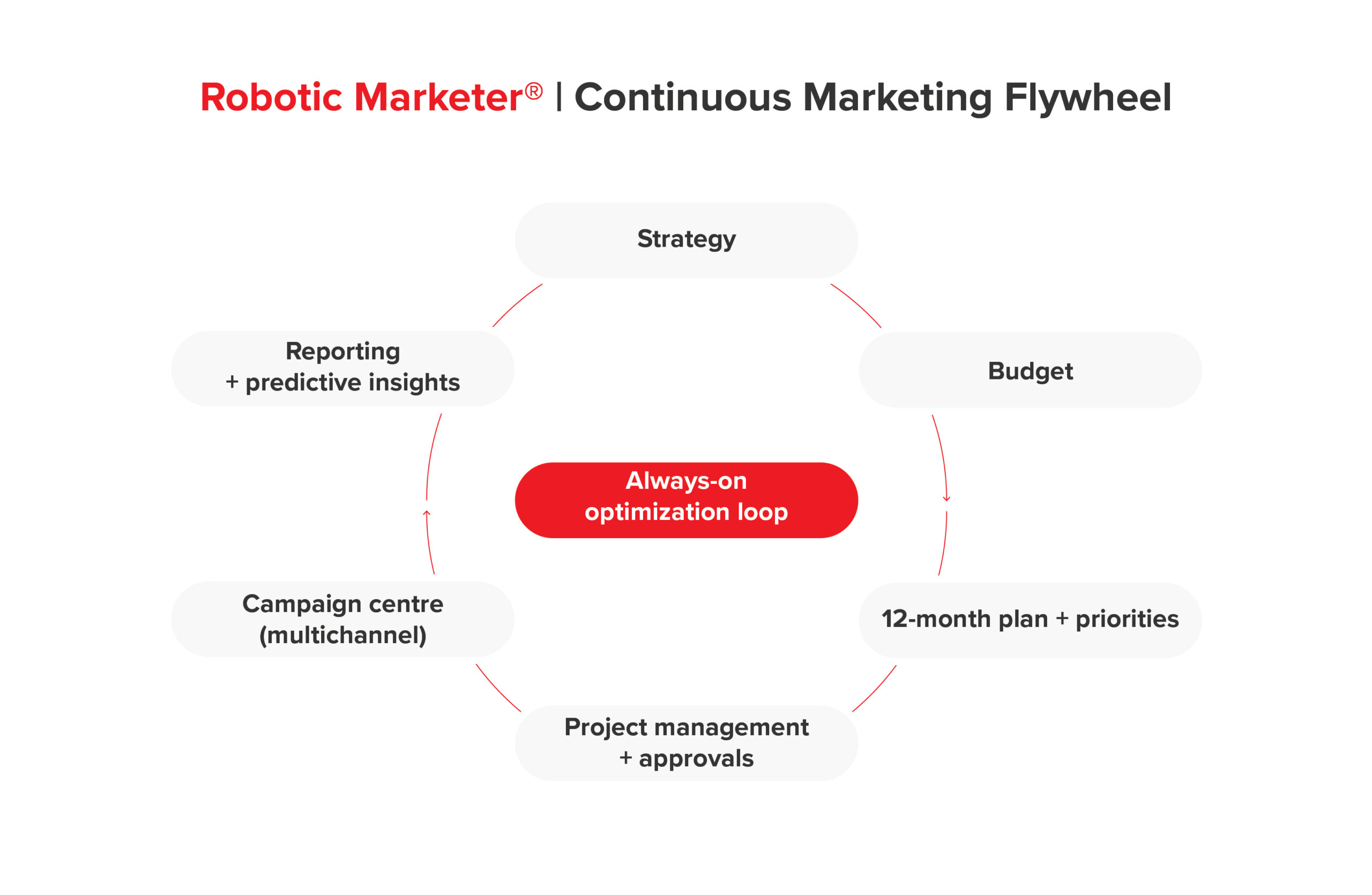
This is where platforms like Robotic Marketer come into play, not as campaign generators, but as strategic systems that bring structure, evidence, and accountability into the planning process.
Why Strategy Work Needs to Happen Earlier Than Most Think
Timing is one of the most underestimated factors in marketing performance.
By the time many teams finalise their plans, budgets are assumed, resources are allocated, and flexibility is limited. Strategy becomes an exercise in justification rather than direction.
The organisations that outperform begin earlier. They use the planning window to challenge assumptions, align stakeholders, and build a strategy that informs budget rather than conforms to it.
This is particularly important heading into 2026, as AI-driven execution reduces the margin for late corrections. Poor early decisions compound quickly.
Early strategy work creates room to manoeuvre. Late strategy work creates pressure.
What a Practical 2026 Strategy Should Deliver
A useful marketing strategy for 2026 should leave a leadership team with clarity on several fronts.
They should know what success looks like and how it will be measured.
They should understand where budget will be concentrated and why.
They should have confidence in the sequencing of initiatives across the year.
They should be aligned on what will be deprioritised or stopped.
They should be able to explain the strategy in plain language, without slides.
If a strategy cannot do these things, it will struggle to guide execution under pressure.
Moving From Insight to Action
Reading about strategy is useful. Building one that stands up in practice is different.
For organisations that want to approach 2026 with confidence, structured strategy work is no longer optional. It is the foundation that allows execution to scale without waste.
This is why we work with leadership teams to develop focused marketing strategies that connect ambition to action and provide a clear roadmap for the year ahead.
For some teams, that begins with a strategy workshop designed to align priorities and pressure-test assumptions. For others, it involves a more comprehensive strategy build that integrates data, performance history, and AI-assisted analysis to create a decision framework for the year.
If you are accountable for marketing outcomes in 2026, this is the right moment to step back from activity and ensure your strategy is doing the heavy lifting it should.
You can explore how our 2026 Marketing Strategy process works and what it delivers here.
[Explore the Robotic Marketer 2026 Strategy Process]