
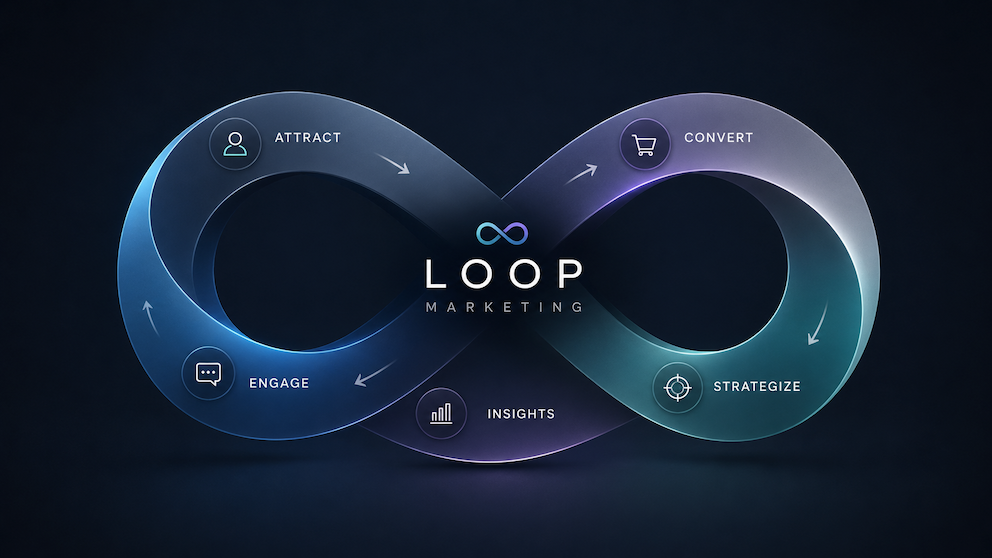
Loop Marketing Is the Operating Model Modern Marketing Has Been Missing
For decades, marketers have relied on structured frameworks like the funnel to guide activities and measure results. These models simplified how organizations understood buyers’ paths from awareness to purchase, dividing each section into manageable phases for planning and reporting. However, the simplicity of those frameworks never matched the real behavior of today’s customers. People jump between channels, encounter brands at different moments, leave and return, and now leverage artificial intelligence for research and recommendations. The buyer’s journey has always been complex, but now, marketers can see this complexity more clearly. This evolving landscape has positioned Loop Marketing as an essential approach, redefining how leading organizations structure marketing operations and make decisions.
What is Loop Marketing and Why Does it Matter?
Loop Marketing challenges traditional, linear thinking. Instead of a funnel with distinct stages, it envisions marketing as a continuous feedback loop. Strategy dictates execution, execution generates performance data, and that data feeds straight back into strategic planning. This model enables organizations to learn and adapt quickly, establishing a direct connection between what they plan, what they do, and what they learn. Continuous feedback ensures no campaign operates in isolation or becomes detached from business objectives. The value of Loop Marketing lies in its ability to transform marketing operations into a living system, responsive to ongoing performance and environmental changes. As businesses navigate digital complexity, this closed-loop approach becomes key to sustainable growth and accountability.
Traditional Campaign Cycles and Their Limitations
Traditional marketing often revolves around an annual strategy with quarterly campaigns, each managed by separate teams, platforms, and reports. Reports often arrive after the campaign ends, making it difficult to act on data before budgets are spent. The result is a lag between action and learning, preventing immediate correction or optimization. Fragmented workflows, disconnected technology, and siloed data slow organizations down. As a result, marketing operations struggle to keep pace with market changes. marketing operations aims to break down these barriers, promoting seamless integration across planning, execution, and analysis. It ensures feedback is actionable, timely, and linked to business goals, allowing marketers to reallocate budgets, adapt messaging, or adjust targeting while campaigns are still active.
How Loop Marketing Powers Modern Marketing Operations
At the heart of Loop Marketing is the continuous alignment of strategy, execution, and performance insight. By linking every activity to a living strategy, organizations avoid working at cross-purposes and focus effort where it matters most. The marketing operations model shifts from managing isolated campaigns to orchestrating interconnected activities. With customer and performance data flowing both ways, marketing teams gain clarity on what is working and what needs refinement. This feedback-driven system enables fine tuning not just after, but during the campaign process. As a result, teams can make decisions confidently, change direction when results diverge from goals, and avoid wasting budget on disconnected tactics. In essence, Loop Marketing supports a culture of learning, agility, and improved return on investment.
The Role of AI in Loop Marketing and Marketing Operations
Artificial intelligence is fundamentally changing what organizations can achieve in marketing. Teams now handle more channels, content streams, and customer data than ever before. Manual review and reaction to this torrent of information is no longer feasible. An AI marketing operations platform helps analyze performance signals, spot customer patterns, and recommend changes faster than any human could. AI is not only a tool for automating repetitive tasks; when properly integrated, it drives connection between strategy and execution. Simply using AI to generate content does not create a marketing loop. AI should turn raw data into insight, guiding real-time decisions and linking every campaign to strategic intent. With smart analysis, recommendations, and workflow automation, AI makes Loop Marketing practical—even for small and mid-sized businesses chasing ambitious growth.
Building Blocks of a Successful Marketing Loop
Establishing a true marketing loop requires more than advanced software or isolated optimizations. Five connected capabilities underpin the model:
- A strategic source of truth: Clearly defined audiences, positioning, priorities, and success metrics provide direction for all activity, keeping efforts aligned and measured against business needs.
- Coordinated campaign execution: Integrated management of content, advertising, social, search, and sales activity translates high-level objectives into actionable market programs. Teams know both what to do and why.
- Customer and market signals: Ongoing collection of website, campaign, social, and sales data feeds the loop with real customer responses, validating or challenging strategy assumptions.
- Operational visibility: Real-time tracking of tasks, approvals, and project status ensures campaigns stay on track and operational issues don’t masquerade as strategic missteps.
- Continuous recommendations: Reporting moves beyond dashboards to actionable insights, providing clear explanation of data, issues needing attention, and suggested next steps.
By bringing these elements together within an AI marketing operations platform, organizations realize the full benefits of Loop Marketing. Instead of a patchwork of tools, they operate a unified, intelligence-driven system.
Loop Marketing versus Funnels: The Changing Buyer Journey
The marketing funnel once reigned as the ideal planning framework, promising a logical sequence from awareness to conversion. Campaigns targeted different stages, reports tracked conversion ratios, and budgets flowed through familiar stages. However, the reality never matched the model. Customers discover brands in unpredictable ways, research across multiple channels, and engage only when and how it suits them. Feedback from performance data rarely arrives in real-time, meaning missed opportunities or late reactions. Loop Marketing addresses these disconnects by accepting that buyer journeys are non-linear, fragmented, and multi-touch. Rather than force-fit activity into rigid stages, teams build systems to listen, learn, and adapt. By adopting a marketing operations framework rooted in Loop Marketing, businesses embrace how decision-making happens today and gain agility in a world where linear paths no longer exist.
AI Marketing Strategy: Guiding Every Action with Intelligence
The promise of Loop Marketing depends on intelligent, data-driven strategy. An AI marketing strategy offers more than a static plan—it continually updates itself with new information, market changes, and performance insights. Effective AI marketing strategies translate organizational objectives, audience detail, competitor analysis, and budget allocation into concrete campaigns with clear expected outcomes. Each campaign then carries those strategic imperatives into its execution. Performance signals—customer impressions, engagements, conversions, and revenue generated—feed back to refine the strategy in real time. By starting with strategy and keeping it central, businesses avoid busywork and focus their resources on marketing activities with measurable impact.
The Importance of Automated Alignment
Strategic context should power every channel, from social and search to email and paid advertising. Fragmented platforms slow down this alignment. An AI marketing operations platform keeps the organization’s “source of truth” accessible and actionable, making sure every team member understands the goals and logic behind each activity. This prevents the all-too-common disconnect between planning and doing.
What Companies Do Loop Marketing and How Do They Compare?
Many leading organizations have begun integrating Loop Marketing frameworks into their marketing operations. These companies recognize that effective use of data and AI separates excellent marketing from average performance. Industry leaders benefit from marketing automation and an AI marketing operations platform that closes the loop between strategy, execution, and reporting. Comparisons often highlight speed, accessibility of strategic insights, and clarity in performance measurement as key differentiators. While traditional systems focus on automating individual tasks or reporting, companies embracing Loop Marketing have raised their game by connecting every touchpoint. Their marketing teams gain real-time access to customer and performance data, keeping campaigns on track and responsive. The main contrast lies in the continuous feedback cycle, which allows these companies to outperform competitors relying on outdated, linear models.
Loop Marketing Is More Than Optimization: Connecting to Core Objectives
Loop Marketing is sometimes misunderstood as synonymous with running A/B tests and optimizing content in real time. While testing is valuable, true Loop Marketing means much more. It requires connecting every activity—ad creative, messaging, content distribution, lead generation, or PR—to the original marketing strategy and broader business goals. The feedback does more than improve an individual AD or email; it shapes what campaigns the business should run and why. Marketing operations must ensure that every activity reinforces strategy, enables learning, and compounds commercial knowledge. Misaligned optimization can produce impressive metrics that do not contribute to revenue or strategic objectives. Loop Marketing prevents this by making performance information actionable at the organizational level, not just the tactical level.
Learning and Asset Creation
One overlooked benefit is the building of organizational marketing intelligence. With each iteration, successes and failures add to a growing data asset, preserving what works and why. This creates a competitive barrier, as deep marketing knowledge cannot be quickly imitated.
The Five Steps to Implementing Loop Marketing in Your Organization
For marketing leaders ready to adopt Loop Marketing, five practical steps provide a roadmap:
- Document a strategic source of truth: Define audiences, priorities, and performance measures in one accessible place.
- Digitally coordinate campaign planning and execution, ensuring strategic context is passed seamlessly from plan to action.
- Integrate systems for collecting customer and campaign signals, enabling immediate understanding of response and results.
- Enhance operational visibility so every stakeholder tracks work, deadlines, and dependencies in real time.
- Leverage an AI marketing operations platform that automates recommendation, reporting, and adjustment, turning feedback into action while campaigns are still live.
By closing the loop through each of these steps, marketers benefit from a system that gets smarter and more effective with every cycle.
Loop Marketing and the Future of AI Marketing Operations
As organizations build increasingly complex marketing systems, the future belongs to those who can connect strategy, execution, and performance insight in real time. Loop Marketing will define the next phase of marketing operations, powered by intelligent platforms capable of learning and adapting continuously. The closed-loop approach is not about abandoning foundational concepts like awareness, consideration, or conversion. It is about recognizing that buyers and markets move quickly, and the organization must keep learning, adapting, and acting just as fast. An AI marketing operations platform becomes the backbone for these advanced workflows, turning raw data into actionable intelligence and ensuring that every campaign, message, and touchpoint advances commercial and strategic goals. The companies that succeed will be those who build systems to listen, learn, and improve—not just once, but endlessly.