
B2B Landing Page Best Practices for High Conversion Rates
A B2B landing page operates as the digital doorstep for a business interested in generating commercial leads. Every marketing strategy aiming for measurable growth relies on purpose-built landing pages to turn prospects into qualified leads. Understanding the specific demands of B2B audiences, from decision-making processes to content expectations, is essential. Whether you manage an AI marketing strategy or a broader marketing automation campaign, the effectiveness of your landing page can mean the difference between pipeline growth and wasted spend. Let us explore how to structure a high converting landing page using proven B2B landing page best practices.
What Defines a High Converting Landing Page?
Every business leader wonders what sets apart a high converting landing page from a generic web form. For B2B marketing strategies, conversion means more than just increasing lead count. It represents the quality and fit of each submission. High converting landing pages deliver clear value, transparency and remove barriers between intent and action. Implementing robust landing page structure ensures the prospect sees exactly what they need—without distraction. A focused message, aligned with a defined marketing strategy, is essential for moving buyers through complex B2B journeys. The most successful examples use data-backed copy, optimised form fields and visual hierarchy to guide users toward one unmistakable call to action.
Key Sections Every High Converting B2B Landing Page Needs
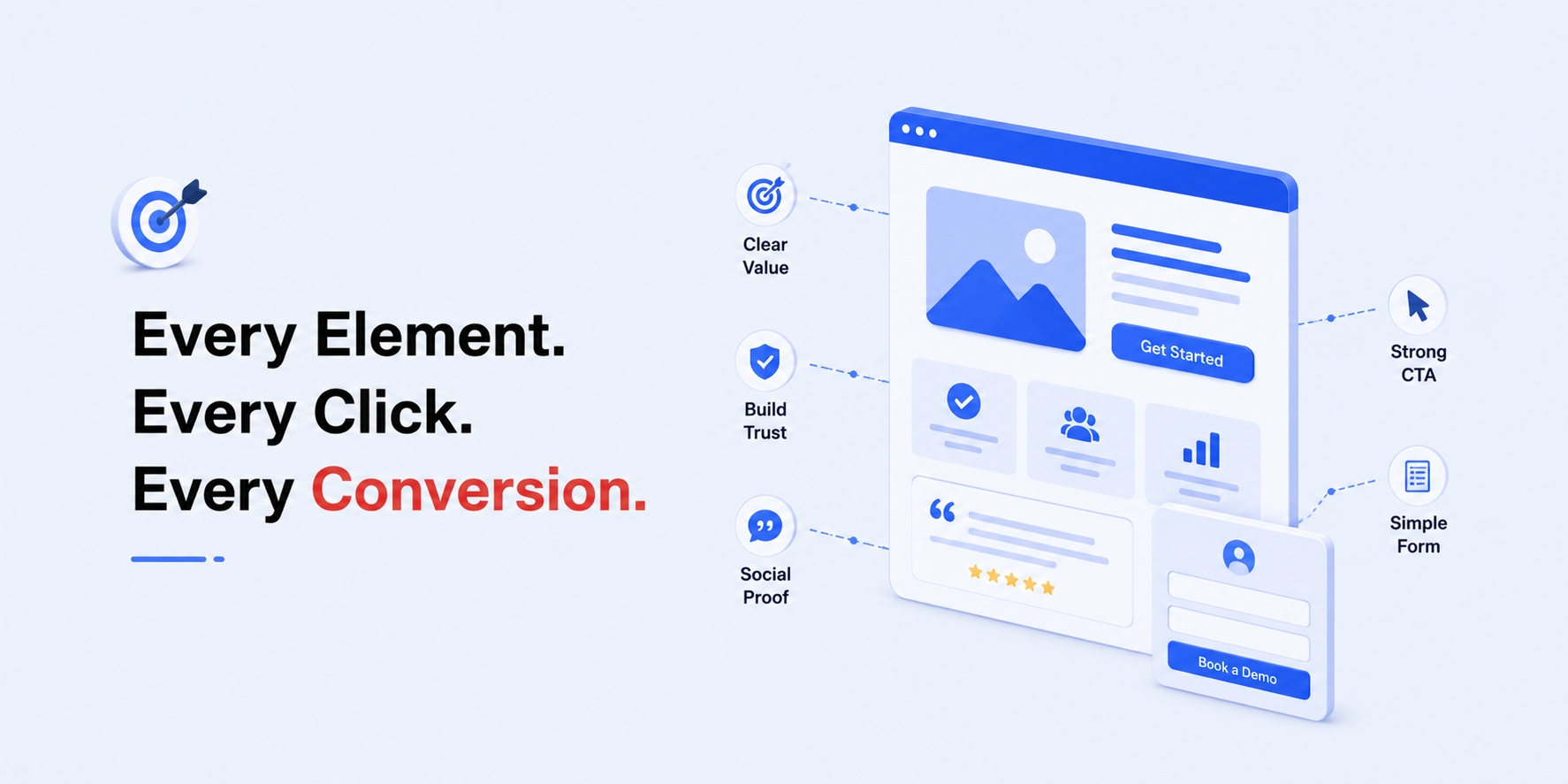
Creating an effective landing page structure means understanding which elements are essential at every scroll depth. Each section must serve a clear purpose, aligned with both marketing strategy objectives and user intent. Below is a breakdown of must-have sections in a high converting B2B landing page:
Hero Section and Above the Fold Messaging
This area should host an attention-grabbing headline, concise supporting copy and a prominent call to action button. Your landing page copy framework must communicate the value proposition within seconds. In the B2B space, clarity matters more than cleverness. Headlines should mention the benefit, such as “Boost Marketing Performance with AI” or “Build Your Perfect Marketing Strategy Instantly”. Place the primary CTA above the fold. Avoid cluttered visuals or excessive detail here. Buyers make initial engagement decisions almost instantly.
Social Proof and Trust Elements
Social proof belongs near the headline or as a supporting band below the hero section. Use recognisable client logos, high-impact testimonial quotes or relevant data points. Awards, certifications and third-party reviews strengthen confidence in the offering. For B2B buyers, credibility often relates directly to perceived risk. The more evidence you place near the point of action, the greater the trust and landing page conversion rate B2B audiences will achieve.
Core Benefits and Value Proposition
Further down the page, outline core benefits using digestible blocks or icons. Address the main pain points your product or service resolves. For AI marketing operations platform offerings, highlight time savings, strategic alignment and real-time insights. Use short paragraphs, bullet points or mini-case studies. Keep content customer-focused not feature-focused.
Detailed Product or Service Description
Offer a clear, concise explanation of your solution. This may include the value of a marketing automation suite, features such as cross-channel reporting or a breakdown of what’s involved in a Book A Demo. Where technical details are necessary, use plain, jargon-free English. Consider adding a video demo for clarity.
Call to Action and Lead Capture Form
The lead capture form or CTA (such as “Book a Demo”) should follow immediately after benefit sections. Reduce friction here by limiting form fields. Make the action button visually distinct. Place secondary CTAs (e.g., “Download Brochure”) further down the page for less committed visitors. Clear, directional microcopy near your CTA button significantly boosts engagement.
Supplementary Social Proof and FAQ
Include a final row of testimonials, press mentions or frequently asked questions near the bottom. Address common objections or hesitations prospects might have. The most effective landing page structure repeats and reinforces trust as the visitor moves toward the bottom.
How Long Should a B2B Landing Page Be?
There’s no fixed rule, but intent and complexity guide optimal length. For simple, high-intent offers like “Book a Demo”, short landing pages work best. For more involved decisions, longer form pages allow prospects to absorb more information before committing. Often, the most successful format offers a concise above the fold section, scannable benefit statements and strategically placed trust signals. Excess content can distract or overwhelm B2B audiences. Regular reviews using landing page A/B testing reveal which length best supports your specific marketing strategy and target persona.
Landing Page Copy Framework: Getting the Messaging Right
Strong B2B landing page copy follows a disciplined framework. First, articulate the primary benefit in a headline. Support this with a short, compelling statement that answers the user’s biggest question: “What’s in it for me?”. Then, provide supporting proof, such as statistics or a testimonial. Use subheadings, short sentences and direct language. Avoid generic, inflated promises. Instead, reference verifiable value, such as “Save 30 hours a month with automated reporting” or “Get your AI marketing strategy in minutes”. Effective copy guides conversation, builds credibility and leads readers toward a single, intentional action.
What Makes a Headline Work Above the Fold?
The highest performing above the fold headlines combine benefit, clarity and urgency. Use active verbs and focus on outcome, not process. In B2B, readers seek solutions not superlatives. Phrases like “Transform How You Plan and Execute Marketing” or “Smarter Marketing Performance Instantly” outperform generic lines. Test headline variations regularly as your business learns from data. This is often the first element to optimise during landing page A/B testing given the measurable impact on conversion.
Design Principles and Landing Page Structure
Great landing page structure isn’t only about content. Visual hierarchy, whitespace and strategic element placement have a direct effect on landing page conversion rate B2B marketers achieve. Remove main site navigation and minimise links that could distract or lead visitors away from the intended action. A single clickable path creates clarity of decision. Consider using directional cues such as arrows or images pointing toward your form fields or CTA button.
Should a Landing Page Keep Site Navigation?
Most best practise guides recommend removing main navigation menus from landing pages. This removes confusion and limits exits. The only exception is a subtle link to legal or privacy statements as required. All other content should push users toward your CTA, with every scroll reinforcing the page’s intended action.
Optimising Forms for B2B Landing Page Conversion
Form design plays a pivotal role in B2B landing page conversion rate B2B businesses aim to improve. Research consistently shows that form fields conversion performance declines as length increases. Collect only the most necessary information. First name, work email and company name often suffice for initial demo requests. If marketing automation or follow-up segmentation requires more data, use progressive profiling after the first conversion step. Reduce friction by clarifying why certain information is required.
How Many Form Fields Is Too Many?
For B2B offers, three to five fields are optimal for high converting landing pages. Beyond five, conversion rates often drop sharply. To maximise form fields conversion, hide non-mandatory questions or use smart field logic. Explain the benefit for submitting data. Trust marks such as “We never share your data” help reassure cautious visitors.
Demo Request Page Optimisation Tactics
Demo offers remain one of the top performing calls-to-action in B2B. Effective demo request page optimisation blends persuasive copy, limited form fields and immediate social proof. Restate the value of attending a demo directly above your form. Show what the user will learn or receive. Offer flexible scheduling or instant confirmation if possible, integrating with your marketing automation suite to deliver responsive communications. Track which demo types, formats and descriptions drive the best engagement over time.
Landing Page A/B Testing: Elements to Prioritise
Landing page A/B testing is essential for continuous improvement, but choosing what to test first can be daunting. Begin with headline text, CTA button copy and placement of social proof. Other high-impact tests relate to form length, image selection or page length. Always test one change per variant and let data build the business case for scaling successful variations. Heatmaps, scroll depth analysis and session replays help diagnose how users interact with your test versions. For AI marketing operations platform teams, empower automation tools to auto-optimise elements at scale based on conversion data.
What Should I A/B Test First?
The highest ROI typically comes from headline A/B testing. This is followed by CTA button colour and copy. Next test form field quantity and arrangement. Once these are performing well, experiment with adding or repositioning social proof. Run tests long enough to reach statistical significance, especially on low-traffic landing pages.
Common Issues: Diagnosing Landing Pages With Traffic But No Submissions
Landing pages that attract visits but see poor submission rates present a unique performance challenge. Begin diagnosis by reviewing analytics: Are visitors bouncing too quickly? If so, headline or offer relevance may be the issue. If users stay but fail to submit, assess form design for friction points. Is there demand for a different marketing strategy, deeper content or stronger trust signals? Use on-page polls or exit intent surveys to collect qualitative feedback. Landing page structure problems are usually revealed by journey mapping or observing actual session recordings. Systematic landing page A/B testing helps isolate variables.
The Role of AI, Marketing Strategy and Automation in Landing Page Success
High converting landing pages do not succeed in a vacuum. They depend on a well-defined marketing strategy informed by business goals, persona insights and channel preferences. AI marketing strategy platforms streamline landing page creation using predictive copy frameworks, automated asset generation and channel-optimised design templates. Marketing automation tools simplify lead routing, nurture sequences and reporting. Integrating an AI marketing operations platform ensures performance data instantly informs optimisation efforts, from A/B testing insights to multi-touch attribution models.
Connecting Landing Page Conversion With Business Growth Goals
B2B landing pages exist to power growth, not just drive vanity metrics. Evaluate success through pipeline value, sales-ready leads and progress toward strategic growth objectives. Link landing page performance with quarterly plans. Review which sources, headlines and form designs produce not just the most, but the highest value conversions. Analytics should inform ongoing campaign tuning and resource allocation so marketing strategies can keep pace with changing customer needs.
Best practises Checklist: Building a High Converting B2B Landing Page
- Define your offer and align with a precise marketing strategy.
- Use a clear, benefit-driven headline above the fold for instant engagement.
- Remove main navigation to focus attention on the conversion goal.
- Place social proof close to your main CTA for credibility. Add testimonials and logos for additional confidence further down.
- Limit lead form fields to three to five for maximum form fields conversion.
- Pace copy using a proven landing page copy framework focused on customer outcomes.
- Employ landing page A/B testing for headlines, CTAs and form variations before experimenting with design and copy tweaks.
- Optimise your demo request page for clarity, brevity and value perception.
- Integrate with a marketing automation suite for instant follow-up and effective lead management.
- Deploy an AI marketing operations platform to continually analyse, optimise and scale successful page elements.
Advancing B2B Landing Page Results With Technology and Human Insight
Building and optimising B2B landing pages is both a technical and creative exercise. Marketers who pair strong strategic foundations with the latest AI marketing strategy tools and robust marketing automation platforms consistently outperform. Every form field you remove, trust marker you add or testimonial you showcase can shift conversion rates and lead value for your business. Regularly interrogating landing page structure, updating your approach based on data, and tying performance directly back to business goals will ensure that your high converting landing page not only attracts more visitors but delivers qualified pipeline growth year after year.