
The role of AI in competitive analysis: staying ahead in a crowded market
Success in crowded markets depends not just on products or pricing, but on how clearly a business understands and responds to its competitors. Artificial intelligence now drives a new standard in competitive analysis, enabling businesses to see further, act faster, and plan marketing strategies with more precision than ever before. Rather than simply streamlining processes, AI brings together immense datasets, delivers actionable insights, and enables brands to adapt immediately, changing what it means to stay ahead.
AI and the new standard for competitive analysis
Competitive analysis forms the backbone of effective marketing strategies. In the past, teams relied primarily on labor-intensive research: Visiting competitor websites, collecting financial filings, or manually monitoring social platforms for any sign of movement. Today, AI-led technology bypasses these limitations. Algorithms routinely scan diverse sources, interpret emerging trends and opportunities, and assemble a detailed competitor picture with remarkable speed, often in minutes.
Rapid data acquisition reshapes research
Manual data collection once represented the single largest bottleneck in competitive analysis. AI automation now continuously sweeps across competitor news, product launches, social updates, press releases, and more, processing it in real time. Human teams are freed from tedious sifting and can instead focus on the interpretation and creativity that drive real business advantage. Huge volumes of raw content, social posts, reviews, forum threads, and news stories, are parsed using natural language processing (NLP) and machine learning. Trends once overlooked or detected days late now appear as soon as they emerge, letting organizations spot not only what competitors are doing, but how their audiences are responding.
AI’s role in mapping competitive strengths and gaps
Pinpointing where rivals are strong or exposed involves linking subtle digital signals. With AI, brands can track competitor messaging shifts, content strategies, campaign cadence, or changes in technical SEO, providing a much deeper look at competitor positioning. Instead of relying on intuition or incomplete reporting, teams have ongoing, data-driven clarity.
Tracking competitor digital footprints
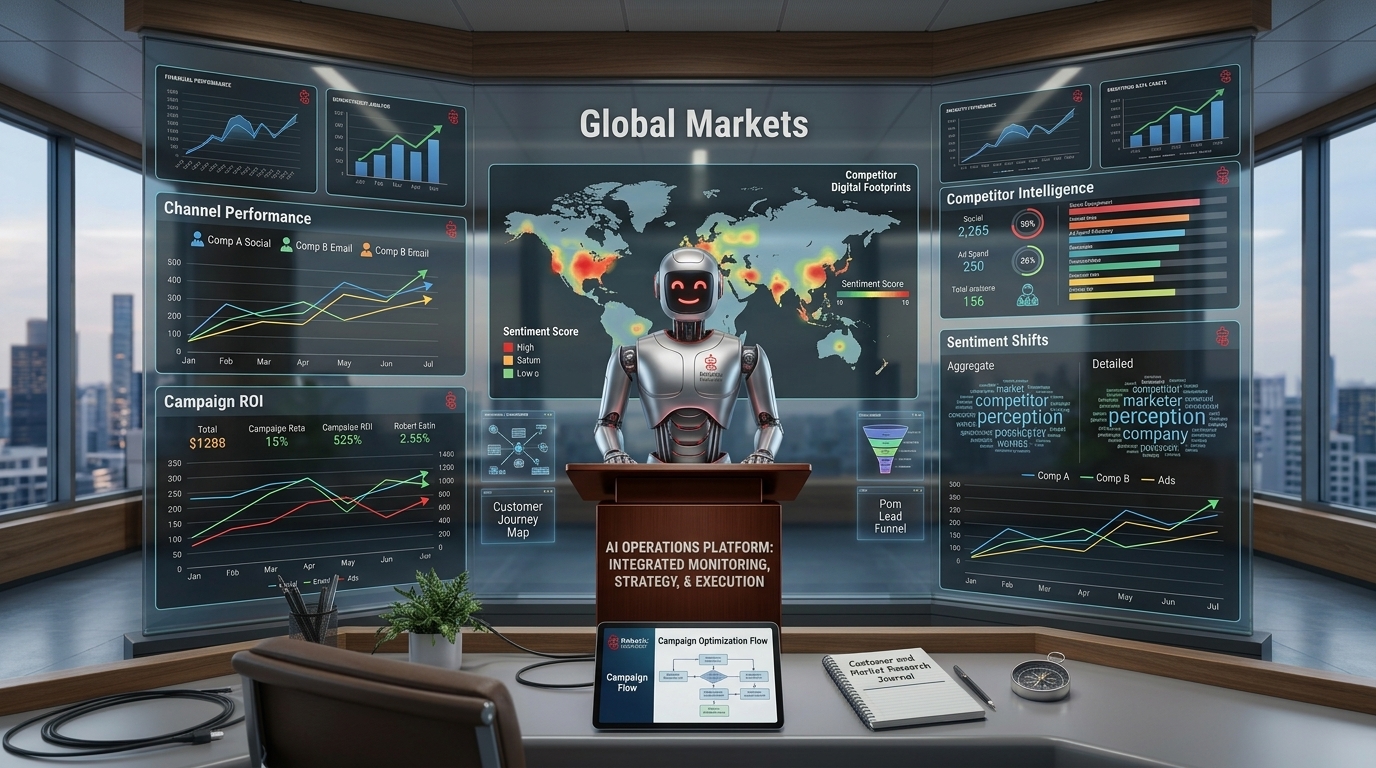
AI tools analyze constantly shifting patterns in web activity, advertising spend, social engagement, and even fluctuations in search keyword rankings. When a competitor ramps up investment in a new segment, launches a viral social campaign, or tweaks its pricing model, these actions surface quickly. Because the analysis is continuous, brands can move from passive observation to proactive response, guiding decisions on everything from campaign timing to budget shifting and audience segmentation.
Understanding customer sentiment shifts
Online conversations, whether in product reviews, forum posts, or social media, generate a signal about how customers feel. AI systems aggregate and analyze this sentiment across millions of interactions, detecting when perceptions around a competitor are improving or deteriorating. Often, this intelligence precedes news cycles or analyst coverage, allowing brands to calibrate their marketing strategies while competitors are still catching up. AI-powered alerts indicate when a rival receives positive attention or when customer dissatisfaction creates an opening for new offers or refreshed messaging.
Predictive analytics in market competition
Putting AI’s predictive power to work, organizations can avoid making decisions based on outdated or incomplete information. Predictive analytics turns past and present data into forward-looking models, showing the likely direction of competitor strategy. Brands can then prepare thoughtful AI marketing strategies, not just react.
Scenario modeling and future planning
Advanced scenario modeling draws from enormous datasets, such as seasonal sales, advertising history, macroeconomic shifts, and cultural trends. AI builds test models simulating competitors’ probable moves, whether launching a product, adjusting branding, or shifting marketing channels. Leaders are then equipped to rehearse these outcomes before committing resources, improving confidence in when and how to move next.
Benchmarking for competitive clarity
Robust benchmarking tracks key performance indicators (KPIs) like conversion rates, efficiency of advertising spend, and engagement rates using AI. Automated systems provide direct, timely comparisons with sector standards or specific competitors. The feedback isn’t just high-level; it directs attention to exact channels or tactics needing attention and ties recommendations to core business objectives. Whether refining messaging, improving campaign execution, or reallocating resources, benchmarking with AI produces focused, measurable action steps.
Integrating AI into marketing strategies
Structured insights from AI analysis drive measurable business outcomes. AI doesn’t just collect data, it links intelligence from competitor activity, consumer behavior, and digital market signals directly to the business goals at the core of marketing strategies. Marketers gain the visibility and confidence to pursue strategies agile enough to shift when conditions demand, but disciplined enough to remain targeted and measurable.
Personalization with precision and scale
Mass personalization, once reserved for the largest enterprises, is now accessible. AI platforms segment audiences, shape content, and suggest precise campaign pivots based on up-to-the-minute competitive and consumer insights. If a major competitor shifts targeting or messaging, AI-driven marketing automation platforms adapt segment strategies, ensuring outreach remains both relevant and resource-efficient. Businesses can consistently engage their core markets without dangerous overextension.
Executing with modern marketing automation
AI-powered marketing automation gives organizations the ability to respond with speed and accuracy. Automated workflows trigger new campaigns, adjust AD placements, or refresh creative elements in response as soon as changes in competitor strategy are detected. Brands no longer rely on periodic manual reviews, but instead operate a continuous cycle of execution and adjustment, supported by real-time data.
Real-time insights and their operational value
Delay in responding to competitive moves translates into missed revenue or shrinking market share. With AI-enabled platforms, teams no longer wait for end-of-month reports. Instead, monitoring happens in real time within integrated dashboards, every campaign, digital channel, and competitor action tracked on a single, unified interface.
Agile reaction to competitor developments
Brands can act on competitor promotions, pricing changes, or emerging sentiment the moment these events occur. Automated alerts and reporting support quick campaign updates, landing page refreshes, or new outreach, preserving competitive momentum before rivals’ initiatives impact consumer decisions. Real-time evaluation means campaigns can be recalibrated as they unfold, making the most of marketing budgets and team energy.
Continuous improvement through campaign optimization
AI’s unique strength is continuous feedback and learning. When a competitor’s campaign succeeds, AI platforms integrate that intelligence to adjust future marketing strategies, ensuring teams incorporate what works industry-wide, not just from internal results. Over time, this drives higher conversion rates, steadier engagement, and more sustained improvements in overall marketing outcomes.
Centralized AI marketing operations: Powering smarter growth
Bringing data analysis, campaign management, and reporting into a single AI marketing operations platform changes the daily reality for marketing teams. Disconnected interfaces and tools, once the source of delays, errors, and inefficiency, are replaced by systems where competitive analysis, execution, and measurement are fully integrated. This structure simplifies day-to-day processes, allowing teams to focus on strategy and creativity rather than systems navigation.
For agencies, SMEs, and enterprise teams, this unified approach means both strategic and operational advantages. Data becomes the foundation of every decision, not just a report used for retrospective analysis. Marketers can compete with speed and clarity, reliably targeting areas with the highest potential for growth and differentiation, regardless of company size or previous analytic sophistication.
Business outcomes linked to AI-driven competition
Organizations that embrace AI-led competitive analysis realize faster campaign cycles, reduced operational costs, and higher return on marketing investment. Accurate insights into competitor movements, rapid response through marketing automation, and smarter AI marketing strategy alignment all combine to produce results: Greater market share, measurable ROI, and stronger partnerships between marketing and the business. Platforms such as Robotic Marketer, bringing together the full spectrum of competitive insight, content automation, and real-time analytics, help define new standards for marketing effectiveness. In this way, data-driven strategy powered by AI is not just a defense mechanism, but an engine for ongoing, measurable growth, even in the most crowded markets.